Last checked September 19, 2026
Claude Central
The source-backed portal for Claude models, plans, apps, Claude Code, API features, prompting, privacy, and official resources.
Signature desk
The Switchboard
Four jacks. One answer as of September 19, 2026: start with Claude Opus 5; Fable 5.1 for demanding long-horizon work; Sonnet 5 for speed and intelligence; Haiku 4.5 fastest and cheapest. Plug a cord for the API ID, the token price, and the sibling to read next.
Guide index
One portal for the scattered official Claude surface
What Is Claude?
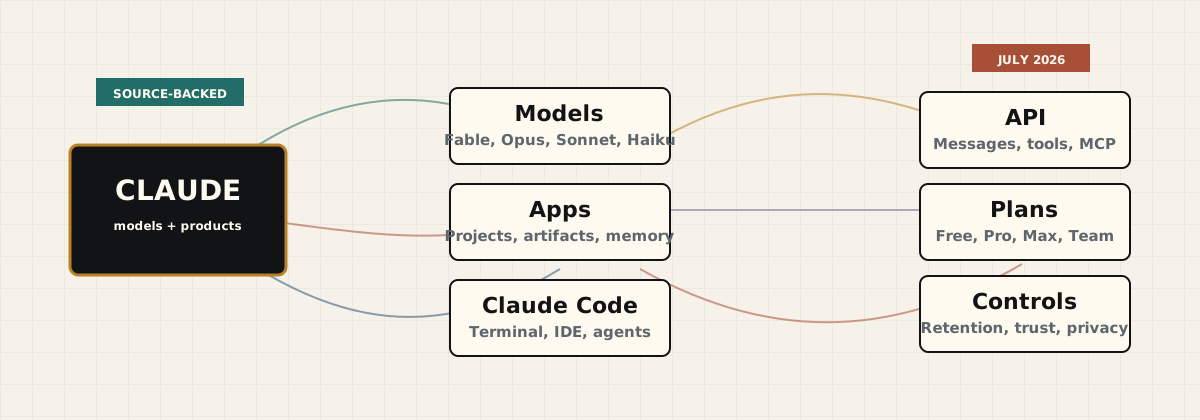
A plain-language guide to Claude, the Claude app, Claude Code, and the Claude API, with official sources for every major claim.
Model mapClaude Models Explained
The September 2026 Claude model lineup: Fable 5.1, Opus 5, Sonnet 5, Haiku 4.5, and Mythos 5.1, with API IDs, prices, context windows, effort defaults, and selection guidance.
Buying guideClaude Plans And Pricing
Claude Free, Pro, Max, Team, Enterprise, API token pricing, and the free Teachers and researcher tracks, explained with dated primary-source links.
Product mapClaude Apps And Product Surfaces
How Claude web, desktop, mobile, Chrome, projects, artifacts, connectors, memory, Cowork, Design, Teachers, @Claude, Science, and Security fit together in September 2026.
Coding agentClaude Code Guide
Claude Code explained: terminal, IDE, desktop, browser, automation, Agent SDK, subscription/API access, and safe usage patterns.
Developer platformClaude API Guide
A practical map of the Claude API: Messages API, tools, web search, MCP, citations, Files API, batches, caching, effort, and cost controls.
Free tools
Navigate the full Claude Network without sending data anywhere
Claude Network Directory
Filter all 19 Claude Network sites by topic, audience, status, and flagship tool, with direct live links to every site.
Guided routingClaude Start-Here Pathfinder
Answer four quick questions and get a personalized path through the Claude Network for your role, goal, experience level, and time budget.
Term lookupClaude Ecosystem Glossary
Search Claude ecosystem terms like MCP, skills, hooks, compaction, CLAUDE.md, artifacts, context windows, and ZDR, with links to the site that owns each topic.
Current model map
Claude’s public model stack changes quickly. Start with the source.
Checked September 19, 2026: the generally available lineup is Fable 5.1, Opus 5, Sonnet 5, and Haiku 4.5, with Mythos 5.1 restricted to trusted access. Anthropic’s official guidance is to start with Opus 5.
Read the model guide- Fable 5.1
- Most capable generally available model. $10/$50 per MTok, cache reads $0.25.
- Opus 5
- The official starting point. $5/$25 per MTok, 1M context.
- Sonnet 5
- Speed and intelligence balance. $2/$10 per MTok, now the standard rate.
- Haiku 4.5
- Fastest, most cost-efficient tier. $1/$5 per MTok, 200K context.
Primary sources
50+ official pages, organized by what they own
Official current model families, IDs, descriptions, and availability.
Claude by AnthropicPricingOfficial plan and API pricing surface.
Claude Code DocsClaude Code overviewOfficial Claude Code surfaces, installation, and automation overview.
Claude Platform DocsUsing the Messages APIOfficial Messages API patterns and stateless conversation note.
Claude Help CenterConfigure custom data retention controlsOfficial Enterprise custom retention behavior.
AnthropicAnthropic Trust CenterOfficial compliance artifacts and control documentation hub.
All Guides
- What Is Claude?Treat Claude as an ecosystem, not one app: the same model family can appear in claude.ai, Claude Code, the API, cloud platforms, and specialized work apps with different controls.
- Claude Models ExplainedStart with Opus 5. Move up to Fable 5.1 for demanding reasoning and long-horizon agentic work, sideways to Sonnet 5 for balanced speed and cost, and down to Haiku 4.5 when throughput and unit economics dominate.
- Claude Plans And PricingPick a subscription for interactive work, pick API billing for production software, treat Team or Enterprise as governance decisions, and check whether the free educator or researcher track applies before paying.
- Claude Apps And Product SurfacesUse the app for human-in-the-loop work, projects for durable context, artifacts for shareable outputs, Chrome and Cowork for delegated action, connectors for permissioned data access, and specialized apps when the workflow has its own tools and governance.
- Claude Code GuideTreat Claude Code like a junior-to-senior pair programmer with tool access: give it clear goals, isolate risky work, require tests, and keep review authority with humans.
- Claude API GuideBuild API integrations around explicit state, source attribution, stop handling, caching, and evals; do not treat the API like the chat app with an HTTP wrapper.
- How To Prompt ClaudeDo not optimize wording in a vacuum. Prompt Claude against a measurable task, then iterate with examples, context boundaries, output contracts, and final self-checks.
- Claude Privacy, Security, And Data ControlsFor sensitive work, verify the exact plan and feature path. EFS is phasing in this fall with ZDR available to eligible Fable customers in the meantime, and some API features remain explicitly not Zero Data Retention eligible.
- Latest Claude Releases And How To Track ThemNever rely on a stale third-party “latest model” article. As of September 19, 2026 the flagship is Fable 5.1 and the recommended default is Opus 5 — confirm IDs, price, and safety notes on official pages before deploying or buying.
- Official Claude Resources And GlossaryWhen in doubt, verify with the source category that owns the fact: docs for API behavior, pricing pages for cost, Help Center for product/plan behavior, Trust Center for compliance, and news for launch context.